
Camera inspection: $300–$750
The first and non-negotiable step. Most operators credit it against the works if you proceed.
A cracked or root-damaged drain does not have to mean a trench through the garden. A resin liner is cured inside the existing pipe from an access point you already have, sealing every joint along the run, and the surface above is never touched.
The failure that brings most people here is not a broken pipe. It is a joint. Older drainage is laid in short lengths, so a single run has a great many joints, and after decades of ground movement and root pressure they open a fraction at a time until something backs up.
A liner seals all of them in one pass, which is why it changes the pattern rather than resetting it. Cutting roots out clears the pipe and leaves the way in exactly as it was, and the interval to the next blockage is set by how fast they grow back.
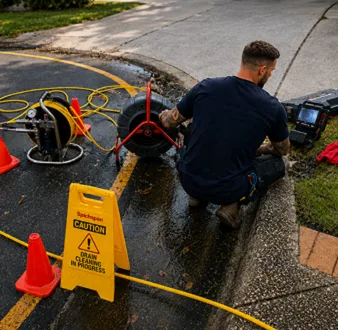
The most expensive time to discover a failing sewer is after new tiling has gone down. The second most expensive is after the slab for an extension has been poured over it.
A camera run costs a fraction of either and takes an hour. If you are getting quotes for a renovation on a house of this age, book it in the same fortnight. Where relining is needed it is far cheaper before the works than after.
The district’s clay swells when wet and shrinks bone-dry in summer, grinding pipe joints apart season after season.
Reactive clay soil moves with the seasons, lifting in the wet and shrinking back in a dry spell. Rigid drainage laid through it gets flexed every year, and the joints are where that movement is absorbed until they stop absorbing it.
It is the reason drainage faults on these soils cluster after a long dry followed by heavy rain. The pipe did not fail that week; it finished failing that week.
This is the honest limit of the method. A liner follows the pipe it is cured inside. If the run has sagged into a belly or lost its fall, relining seals it and leaves the shape exactly as it was, so the water still pools where it pooled before.
Most Green Valley homes still run their original earthenware drains, and half a century of settling has cracked joints and created bellies that trap waste.
On sloping ground that failure mode is common enough to check for specifically. Where the profile is wrong, the correct answer is excavation and re-lay of that section, and we will tell you so even though it is the more expensive quote.
On a clay line the barrel is usually fine. What has gone is the mortar or rubber ring at each joint, and there is one every few hundred millimetres, which is a great many small openings after sixty or eighty years in the ground.
Green Valley anchors South-West Sydney’s Liverpool district (postcode 2168), bordered by Hinchinbrook, Busby and Cecil Hills, with streets of solid 1960s brick and fibro homes laid out during the estate-building boom. Those original clay sewer lines are now past their 50th birthday, which keeps local drains temperamental.
That matters for the quote. You are not replacing a pipe, you are sealing a long series of joints, and a liner does the whole run at once rather than patching them one at a time.
Removing a mature tree is expensive, often needs approval, and frequently does not solve it: the roots already inside the pipe do not leave when the trunk does, and the joint is still open for the next one.
Mature gums and bottlebrush planted with the estates now drive roots into any sewer crack within reach, weaving mats that snag paper and waste.
Relining lets both things be true at once. The garden stays as it is and the drain stops being a route to water. For most owners that is the whole appeal, and it is why no-dig gets specified on established blocks far more often than on new ones.
The first and non-negotiable step. Most operators credit it against the works if you proceed.
Domestic sewer across Sydney in 2026. Longer single runs sit at the lower end of it.
Seals one defect. Right where the rest of the run is sound and the ground is stable.
Length, diameter and how many branches need reinstating are what move the number inside that band.
Excavation is only half the cost. Replacing the driveway or garden above it is the other half.
Figures reflect the 2026 Sydney market rather than a quote. You get your own number once we have seen inside the pipe. Figures here are indicative of the 2026 Sydney market rather than a quote from us, you get your own number as a fixed price before any work starts.

Nothing is priced until a camera has been down the line. The survey is recorded, distances are marked from a known point, and the footage is yours.
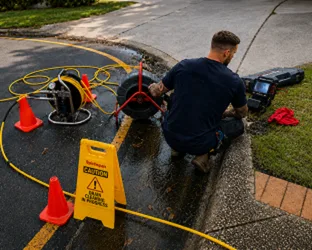
A single defect in a sound run wants a patch. A run failing along its length wants a full liner. A collapsed or sagging section wants excavation. The camera decides, not the quote.
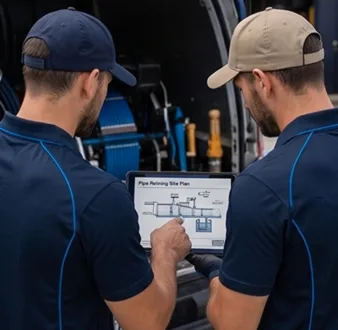
Jet clean, install through the existing opening, cure in place. Water is off for part of the day and nothing above the pipe is disturbed.

Junctions reinstated, final camera run, and the compliance paperwork where the work is notifiable. You keep both recordings.
Send it through and we will come back with what it is likely to be, what the survey costs, and whether relining is even the right conversation.
Cost, lifespan, method, and the cases where a liner is the wrong answer.

Call for the fastest answer, or send the form and we will arrange a camera survey before anything is quoted.

Leave your details and our local Green Valley team will call you back fast.